Reuben Lucius Goldberg (1883-1970)

 - 1st Class Levers:In a first class lever the pivot (fulcrum) is between
the effort and the load. In an off-center type one lever (like a
pliers), the load is larger than the effort, but is moved through a
smaller distance.
- 1st Class Levers:In a first class lever the pivot (fulcrum) is between
the effort and the load. In an off-center type one lever (like a
pliers), the load is larger than the effort, but is moved through a
smaller distance.
- 2nd Class Levers : In a second class lever, the  load is between the
pivot (fulcrum) and the effort.
- 3rd Class Levers: In a third class lever, the effort is between the pivot (fulcrum) and the load. Some common examples of third class lever include; fishing rod, tweezers, and mouse traps.

 Fixed Pulley:The fixed pulley when attached to an unmovable object e.g. a ceiling or wall, acts as a first class lever with the fulcrum being located at the axis but with a minor change, the bar becomes a rope.
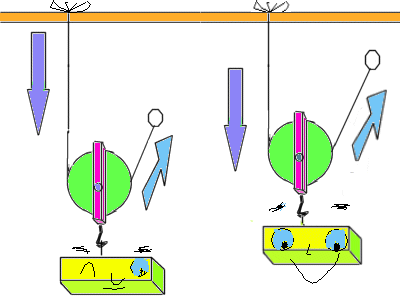
Moveable Pulley:The movable pulley allows the effort to be less than the weight of the load. The movable pulley also acts as a second class lever. The load is between the fulcrum and the effort.
 Combined Pulley:A combined Pulley makes life easier as the effort needed to lift the load is less than half the weight of the load.The main advantage of this pulley is that the amount of effort is less than half of the loadThe main disadvantage is it travels a very long distance.
 Wheel and Axle:
A wheel and axle is a lever that rotates in a circle around a center point or fulcrum. The larger wheel (or outside) rotates around the smaller wheel (axle).
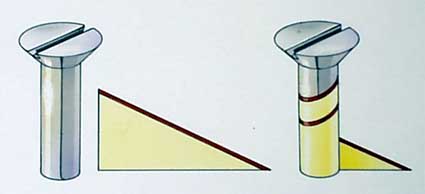
 Wedge: the wedge works just like a ramp: The narrower the
wedge (or the sharper the point of a wedge), the easier it is drive it
in and push things apart.
Wedge: the wedge works just like a ramp: The narrower the
wedge (or the sharper the point of a wedge), the easier it is drive it
in and push things apart.
 Inclined Plane:It can be as simple as the driveway leading
to your school or as sophisticated as the staircase in the Empire State
Building. A ramp works by helping you lift things more easily up to a
higher level. It can be really difficult to carry a box of stuff up a
ladder. But carrying that same box up a staircase is an easier job, and
carrying it up a smooth ramp is even easier.
Inclined Plane:It can be as simple as the driveway leading
to your school or as sophisticated as the staircase in the Empire State
Building. A ramp works by helping you lift things more easily up to a
higher level. It can be really difficult to carry a box of stuff up a
ladder. But carrying that same box up a staircase is an easier job, and
carrying it up a smooth ramp is even easier.